

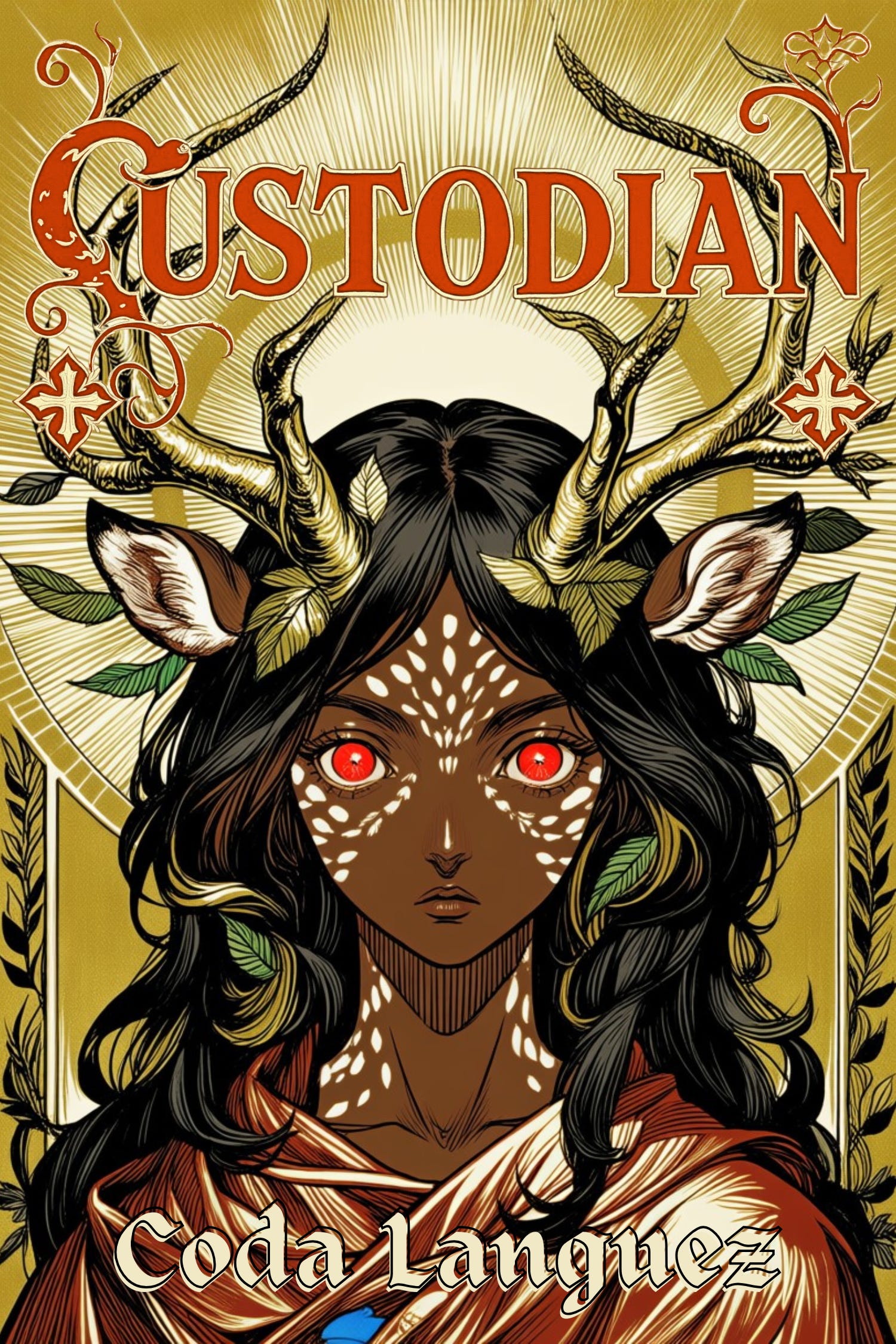
The antlers regrow in the spring.
The velvet phase lasts six weeks. The recent growth emerges from the pedicles as soft, furred columns, blood-rich, covered in skin so thin the capillary network pulses beneath it, a branching map of red and blue that radiates warmth like a halo. I am aware of the theological implications of comparing any part of her to a halo, and I am noting them and I am continuing.
The velvet antlers are sensitive in the way the inside of a wrist is sensitive: to temperature, to pressure, to the brush of a fingertip. I discovered this while tending them.
The tending is necessary. The tines branch at angles that catch on ceiling beams, on the chain, on stone. I found her once with a tine wedged between wall-stones; the velvet scraped raw; the capillaries weeping a blood brighter than human blood. I filed the points the same afternoon. A farrier’s rasp, borrowed from the smithy under the pretense of woodworking. She sits on the pallet. I kneel before her. The priest kneeling, again, in the posture of prayer repurposed for a purpose the prayer never expected. I hold the main beam with my left hand, the velvet warm, her heartbeat against my palm, and I file with the right. Bone-powder falls on her shoulders like snow on dappled ground.
She tilts her head into the filing. Presses the antler harder against the rasp. Not the trained behavior. The creature seeking the sensation. Her ears go forward, the tips soft, the posture of a comfort that exceeds the quiet after, the feeding, the holding-during-storms. Her eyes close. The ruby irises disappear behind lids that are the most human part of her face, thin-skinned and veined. A creature closing its eyes before a man holding a rasp to its skull, and believing.
